
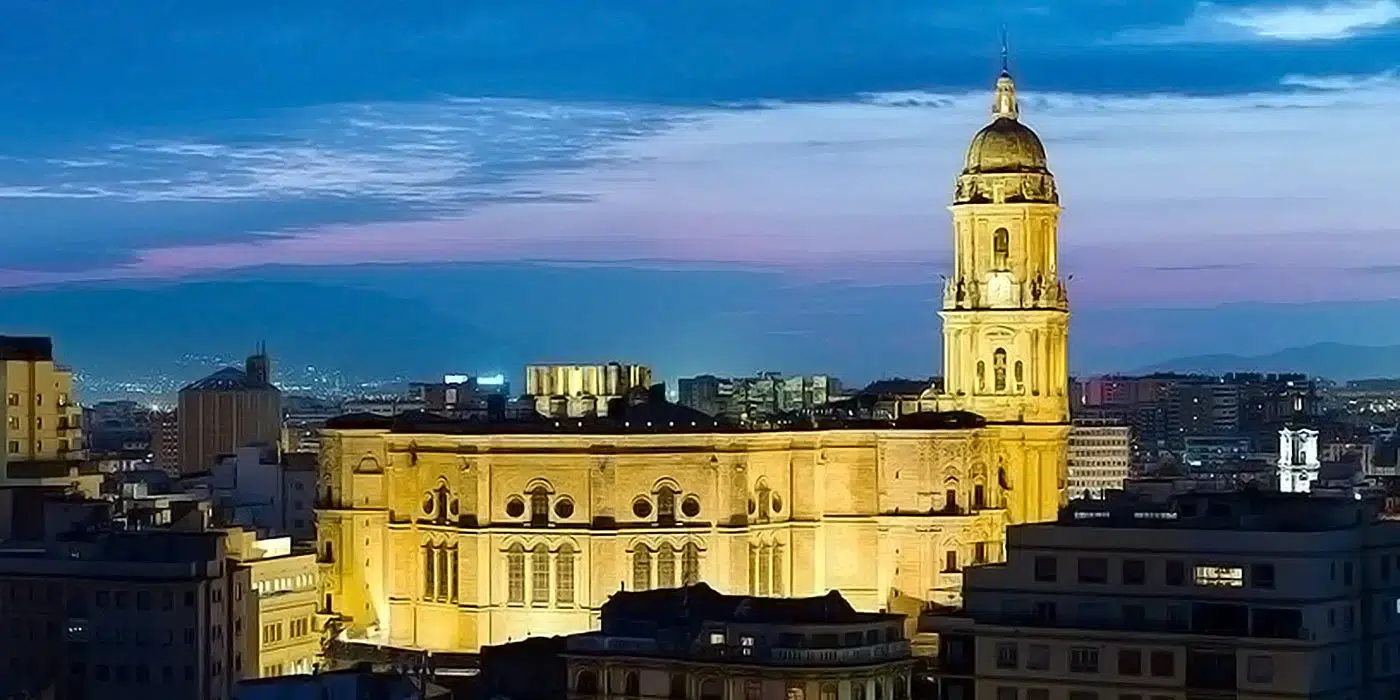
The imposing main façade of the Cathedral of the Incarnation of Malaga, seen from the Plaza del Obispo. The Cathedral of the Incarnation of Malaga, affectionately nicknamed La Manquita (“the One-Armed Lady”), is one of the city’s most iconic monuments.
If you’re staying at Hotel Alcazaba Premium, you’re in luck, this historical treasure is just 400 meters away. In barely five minutes on foot, you can enjoy a pleasant walk through the old town’s charming streets leading to the impressive Renaissance cathedral, inviting you to discover centuries of art and history.
History of the Cathedral of the Incarnation of Malaga

The history of Malaga Cathedral dates back to the Reconquest of the city. After the capture of Malaga by the Catholic Monarchs in 1487, they ordered the construction of a Christian temple on the site of the city’s former Great Mosque.
The official construction of the new cathedral began in 1528 and continued, with numerous interruptions, until 1782, over 250 years later, when the works were declared completed, though still unfinished
This long construction period, spanning the 16th, 17th, and 18th centuries, resulted in a cathedral with a fascinating mix of styles: it began with late Gothic influences, evolved into a magnificent Renaissance design, and later incorporated Baroque additions in the 18th century.
In the 19th century, Pope Pius IX granted it the title of Minor Basilica in 1855, further enhancing its religious significance.
Over the years, the Cathedral of the Incarnation has witnessed numerous historical events. During the Spanish Civil War, it suffered some damage and loss of heritage, though chapels and artworks were later restored.
In more recent times, the Cathedral has continued to adapt. For example, in 2015, visitors were allowed to climb its rooftop on guided tours, offering breathtaking panoramic views of Malaga.
The Cathedral of Malaga is officially listed as a Site of Cultural Interest and is widely recognized as one of Andalusia’s architectural gems
Curiosities about the Cathedral of the Incarnation
Malaga’s cathedral impresses not only for its history but also for its fascinating curiosities and unique details that capture visitors’ attention.
La Manquita’: Malaga’s One-Armed Cathedral
One of its most famous features is its nickname, La Manquita (‘the One-Armed Lady’), which reflects the many changes during its construction. The original design included two bell towers on the main façade, but only the north tower was completed, leaving the south tower unfinished. Hence, the cathedral’s affectionate nickname.
According to a popular, though unconfirmed, story, the funds intended to complete the second tower were instead used to support the American War of Independence, in which Spain aided the United States against Great Britain.
Far from being seen as a flaw, locals have embraced this peculiarity with pride. Beautiful yet imperfect, La Manquita symbolizes Malaga’s resilient spirit. Even today, there are occasional debates about whether the missing tower should finally be built, but many feel that La Manquita has already become an inseparable part of the city’s identity.
The Patio de los Naranjos

Closely tied to its Muslim past, Malaga Cathedral preserves a courtyard with orange trees that evokes the courtyard of the original mosque.
This charming garden, accessible via Calle Císter, offers a peaceful corner with a fountain and shade from the orange trees, a perfect spot to admire the exterior of the cathedral.
Walking through the Patio de los Naranjos lets visitors imagine the blend of cultures that shape Malaga’s history. You can still spot small traces of Islamic architecture subtly integrated into the surroundings.
Interior of the Cathedral of the Incarnation

The interior of the Cathedral houses numerous artistic treasures. Particularly noteworthy is the magnificent choir stalls, considered a masterpiece of Baroque woodcarving. Crafted from mahogany in the 17th century, it includes 42 sculpted figures of saints and religious figures, remarkable for their expressiveness and fine detail.

You’ll also find two monumental 18th-century pipe organs (built between 1779 and 1781). These twin organs astonish visitors with their elaborate horizontal trumpets and over 4,000 pipes, and they still resonate during live concerts today.

Throughout the cathedral and its chapels, visitors can admire works of art by notable artists, including Italian paintings in the Main Chapel, an original canvas by Alonso Cano in the Chapel of the Rosary, sculptures from the Granada school, and other 16th-century pieces.
Each side chapel has its own story, adding unique details to Malaga Cathedral, from the tombs of distinguished bishops to reliquaries and artworks brought from other places to replace those lost during turbulent times.
Altogether, these elements make the Cathedral of Malaga a living museum of sacred art and architecture, where every corner has something to tell.
Climbing the Cathedral Rooftops

Thanks to a recent restoration project, visitors can now access the upper part of the structure on a guided tour, walking along walkways between the vaults, and enjoy spectacular panoramic views of the city.
From the top of the north tower, standing 87 meters high, you can see nearby landmarks such as the Alcazaba and Gibralfaro Castle, the old town of Malaga, and even the Mediterranean Sea on the horizon.
This climb, which requires a bit of effort since there are nearly 200 steps, has become one of the favorite activities for photography and history enthusiasts. It offers a privileged perspective to admire the domes and buttresses of the Cathedral of the Incarnation up close.
Tips for Visiting the Cathedral
Here you’ll find useful information to plan your visit — including location, opening hours, ticket prices, and dress code.
Location and How to Get to the Cathedral
The cathedral is located at Calle Molina Lario, 9 (View location), right in the heart of Malaga’s historic center.

Its main entrance opens onto Plaza del Obispo, just a few steps from the popular Calle Larios and within walking distance of other major attractions such as the Picasso Museum and the Alcazaba itself (View on Maps)
From Hotel Alcazaba Premium, the easiest and most pleasant way to reach the Cathedral is on foot. The short walk takes you through lively pedestrian streets full of charm. (Suggested route)
If you’re coming from further away, several city bus lines (1, 3, 4, 7, 11, and 19) stop at Alameda Principal, just a few minutes’ walk from the Cathedral.
Driving is also possible, though keep in mind that Malaga’s city center is mostly pedestrian. If you plan to drive, there are nearby public car parks such as Parking Plaza de la Marina or Parking Camas.
Opening Hours
The Cathedral of the Incarnation of Malaga offers extensive visiting hours throughout most of the year, although they vary slightly depending on the day of the week and may change during religious holidays.
| Monday to Friday | 10:00 – 20:00 |
| Saturday | 10:00 – 18:00 |
| Sunday & Holidays | 14:00 – 18:00 |
Please note that the last admission is approximately 45 minutes before closing time to allow visitors enough time to complete the tour.
Tip: Every morning, from Monday to Saturday between 8:30 and 9:00 a.m., and on Sundays between 8:30 and 9:30 a.m., there is a short time slot when entry to the Cathedral is free for those attending mass or wishing to make a brief visit. Keep in mind that no audio guides are provided during this time as it coincides with religious services.
During major festivities such as Holy Week or Christmas, the schedule may vary, so it’s advisable to check in advance.
Cathedral Entrance Fees
Admission to the Cathedral is paid (except for certain cases) and usually includes a multimedia audio guide available in several languages.
The general ticket costs €10 and includes access to the Cathedral, the Cathedral Museum, and the audio guide.
Reduced rates are available for students, young visitors, seniors over 65, and groups of more than 15 people.
Tickets can be purchased directly at the Cathedral’s ticket office on the day of your visit (usually located in the Patio de los Naranjos, on the side of the building). However, during weekends or high season, you may encounter some queues. For convenience, you can also buy tickets online in advance through the Cathedral’s official website.
Visiting the Rooftops

As mentioned earlier, climbing the rooftops of the Cathedral of the Incarnation of Malaga is a highly recommended experience.
This visit has separate access and tickets from the general tour and is usually conducted in small groups accompanied by a guide, with several time slots per day. For example, visits are often scheduled from Monday to Saturday at 11:00, 12:00, 13:00, and 16:00
Exact schedules may vary depending on the season and weather conditions, as visits are suspended for safety reasons in case of rain or strong winds.
The price of this activity is around €6 per person for a daytime visit, and it usually increases for nighttime visits.
There is also a combined ticket for both the Cathedral and Rooftop visit, costing around €15 for general admission, ideal for those who wish to experience both tours.
Please note that since there are over 200 steps, this activity is not suitable for people with reduced mobility or certain health conditions.
Rooftop passes tend to sell out quickly during high season, so it’s best to inquire at the ticket office early in the day or book online in advance.
Practical Tips for Visiting the Cathedral of the Incarnation
As it is an active place of worship, visitors are encouraged to dress modestly, avoiding overly revealing clothing, and to maintain respectful behavior inside.
Photography without flash is allowed in most areas, but not during masses.
It’s advisable to silence mobile phones and refrain from touching artworks or crossing security ropes.
The temperature inside the cathedral tends to be cool even in summer, so bringing a light jacket might be a good idea.
The typical visit takes around 45 minutes to one hour to explore everything at a relaxed pace (not counting the rooftop climb)
Monday mornings are free entry, so it’s usually busier early in the day. If you prefer a quieter visit, late afternoon hours are ideal to enjoy the atmosphere with fewer crowds.
In conclusion, the Cathedral of the Incarnation of Malaga is an unmissable cultural landmark that blends history, art, and spirituality, and it happens to be just a few steps away from your stay at Hotel Alcazaba Premium.
Whether you’re gazing up at its soaring vaulted ceilings, admiring the craftsmanship of the wooden choir stalls, or simply relaxing under the shade of the orange trees in its courtyard, a visit to the Cathedral promises to be a truly memorable experience.


